

 New fuel price hikes could create another crisis for Cambodia’s agricultural sector, with farmers already facing high costs for fertiliser now having to pay more for energy. An expert warns that without better rice prices or cheaper fuel, more rural families will fall into poverty and debt
The global pressure of fuel shortages and price hikes, including rising operational costs and low market returns, are pushing Cambodia’s agricultural sector to a breaking point.
From March 14 to 16, the price of regular gasoline hit 5,400 riel per litre, with diesel, rising to 6,400 riel a litre, according to the Ministry of Commerce.
Theng Savoeun, president of the Coalition of Cambodian Farmer Community, said when gasoline prices rise, it increasingly burdens farmers who need to use fuel to pump water to irrigate their fields.
“We already know that in the past, the increase in prices of agricultural inputs, such as fertilisers and pesticides, has been a problem for them, while at the same time, rice and other agricultural products have dropped in price,” he said.
“This means they work hard to produce, but their income cannot cover their expenses, leading some to fall into poverty and further debt. Now, their work activities will become even more difficult because of the issues related to the conflict in the Middle East."
Savoeun said it is time for the government to consider farmers’ needs, such as increasing and encouraging them to use renewable electricity, including arranging for investment companies to install solar panels to protect the crops.
“Therefore, let's question the government, what will they do to change the behaviour of energy use among farmers nationwide?” Savoeun asked.
A pesticide seller, who spoke anonymously, confirmed that many farmers have already been battling challenges, with this situation adding to their load. “As I work with many of them, I can see clearly that they are suffering as their expenses are higher than their income,” he said.
He also pointed out that he recently met farmers in Prey Veng province who mostly rely on rice cropping - some have more than 10 hectares of rice fields - with many stating they cannot motivate themselves to continue their careers.
However, he remains confident that even if fuel prices continue to increase, along with rice prices, it will not pose a big threat to farmers.
Kaing Herl, 53, a farmer in Ba Phnom District, Prey Veng province, told Kiripost, "I have 20 hectares of rice. In the dry season, I plant a rice variety that takes three months to harvest. It is still hard to make money because the sale price is so low, with 600 to 700 riel per kilogram (paddy rice).”
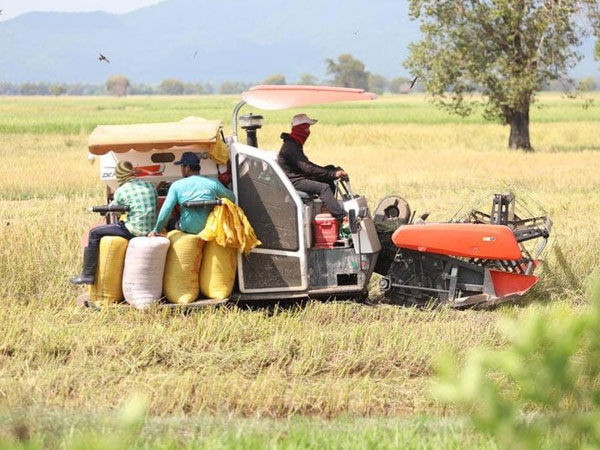
The fuel problem is now adding to this, forcing farmers to spend more. “We spend more but earn less. Fertiliser and rice harvest machines have also increased. How can we balance our costs when all income goes to help our families and pay back the bank loan?”
While Herl did not specify how much debt he is in, he noted that other farmers have been forced into other jobs, as they cannot benefit from farming. “Others who can change jobs will do so if the situation forces them to change. But for me, I grew up with rice fields, I cannot do anything more.”
As a farmer and supplier in a rural area, Herl confirmed that he needs a better price to sell rice, as well as fuel price decreases. He said he just harvested another round of rice, but was unable to earn much. He is now unsure whether to plant another round of rice as the cost calculation is not favourable.
According to the Cambodia Rice Federation, as of March 13, paddy prices sat at around 600 to 800 riel a kilogram, based on location.
Seng Sovan, a farmer in Battambang province, told Kiripost he has decided to shift from farming for a while as he has been losing income from rice farming for many years. “I have stopped [farming] for a while as it is not beneficial, and am working at a private company,” he said.
In the last few days, a joint working group of the Ministry of Commerce confirmed that more than 2,000 fuel stations and depots have either closed or suspended operations without being assessed for compliance by the competent authority.
After the joint working group inspected and assessed the locations in cooperation with the owners of the stations and depots, it was found that only more than 400 locations remain closed or have suspended business operations due to the delay in the arrival of new stock. The rest have gradually reopened as of March 13, the ministry confirmed.
Khim Finan, spokesperson for the Ministry of Agriculture, Forestry and Fisheries (MAFF), stated that in relation to oil and fuel gas issues, MAFF’s minister has talked with the Minister of Mines and Energy and the Minister of Commerce to work together to ensure the supply of fuel to support the agricultural sector.
“MAFF has issued guidance to all local authorities, especially Departments of Agriculture, to closely monitor the actual situation in their areas and cooperate with the Departments of Mines and Energy, as well as the Department of Commerce to provide immediate intervention if there are abnormal price increases or supply shortages,” he said.
Regarding fertiliser issues, Finan confirmed that recently MAFF held an assessment meeting with several major fertiliser import and distribution companies, and initially assessed that Cambodia will not encounter a fertiliser issue.
However, he noted that there may be an increase in prices due to global market pressures. The ministry has also requested that companies maintain prices at a reasonable level that is acceptable for farmers for the upcoming planting season.






© Copyright 2025 The SSResource Media.
All rights reserved.