

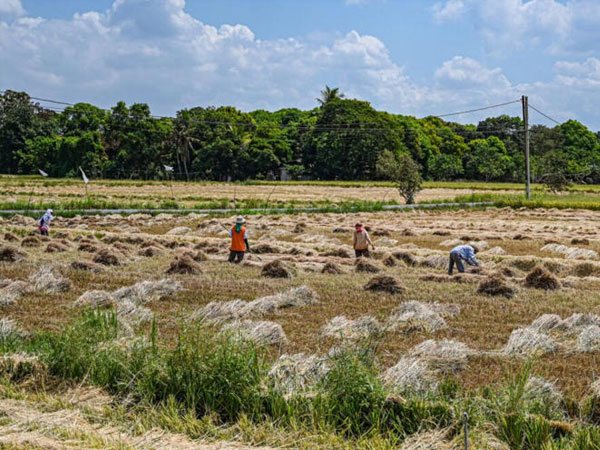
 A critical food security challenge in 2026 looms over the Philippines, as projections for rice imports diverge widely amid the Super El Niño 2026 forecast and other other factors. While the Department of Agriculture estimates 3.6 to 3.8 MMT, assuming record palay output of 20.3 MMT, the U.S. Department of Agriculture projects rice imports at 5.1 million metric tons (MMT).
Such a gap reflects the difference between international risk-adjusted forecasting and domestic production targets.
A forecasted Super El Niño from June to December 2026, elevated fertilizer and oil prices linked to the ongoing war in the Middle East, and the absence of a guaranteed Minimum Support Price (MSP) for farmers suggest both projections may underestimate risk.
Factoring in El Niño and global shocks, imports could rise to 5.5 to 6.0 MMT. Without decisive action, the country risks deeper import dependence, rising prices and broader stability concerns.
Food security must be treated as national security. Asean peers integrate buffer stock systems into defense strategies, while the Philippines remains exposed. A Rice Emergency Proclamation could stabilize supply and prices, protect farmers and signal that government is prepared to defend food security as vigorously as territorial sovereignty.
Key risks
- Palay output could fall to 17 to 18 MMT, erasing recent gains
- Fertilizer and oil shocks could inflate production costs and consumer prices
- National Food Authority (NFA) reserves cover only seven to 15 days of consumption, far below ASEAN peers
- Imports could rise to 6.0 MMT or more, increasing exposure to volatile global markets
- Vietnam, which supplies 80% to 90% of Philippine rice imports, may also be affected by a Super El Niño. Vietnam exports about 8 to 9 million tons; sourcing 5 million tons could be difficult if El Niño conditions disrupt production
Rice remains the cornerstone of Philippine food security, accounting for more than 40% of caloric intake and serving as the staple for more than 110 million citizens. The country’s vulnerability to supply shocks has been magnified in recent years by climate variability, global market disruptions and institutional constraints under the Rice Tariffication Law (RTL). In 2026, the USDA projects rice imports at 5.1 MMT, a 15.9% increase from 4.4 MMT in MY 2025-2026, based on palay production of 19.68 MMT. In contrast, the DA projects a lower import requirement of 3.6 to 3.8 MMT, assuming record palay output of 20.3 MMT.
This divergence highlights a policy dilemma. The USDA forecast reflects risk-adjusted modeling that accounts for modest growth and historical volatility, while the DA projection is anchored in program targets. However, the forecasted Super El Niño, elevated fertilizer and oil prices, and the absence of a guaranteed MSP suggest import requirements could be closer to 5.5 to 6.0 MMT, underscoring the urgency of decisive government intervention, including a possible Rice Emergency Proclamation.
Super El Niño forecast
The latest outlook shows a high probability of a “Super El Niño” in late 2026, with an estimated 70% to 75% chance, according to the European Centre for Medium-Range Weather Forecasts (ECMWF).
What the forecasts are saying:
- European model (ECMWF): Indicates a 75% chance that sea surface temperatures in the eastern Pacific Ocean will be warmer than normal by October 2026, signaling a potential “Super El Niño.”
- NOAA Climate Prediction Center (CPC): As of April 2026, conditions remain ENSO-neutral, but there is a 61% chance that El Niño will emerge between May and July and continue through year’s end.
- International Research Institute (IRI): Shows a rapid increase in the probability of El Niño developing from May to July, with chances rising to 72% to 80%.
- Weather Channel analysis: Warns that if a Super El Niño develops, it could be one of the strongest in recent decades, with significant impacts on rainfall, temperatures and the hurricane season.
Global rice trade has become increasingly volatile due to export restrictions, climate shocks and geopolitical disruptions (USDA, 2026). India’s intermittent export bans, Vietnam’s climate-sensitive production and Thailand’s reliance on irrigation contribute to uncertainty in global supply chains.
Philippine rice production has stagnated despite government programs under the RTL. Studies show palay yields remain highly dependent on rainfall, with more than half of rice lands classified as rainfed (Briones & Tolin, 2024). Irrigation systems are also rainfall-dependent, making them vulnerable to prolonged droughts. Fertilizer costs, driven by global oil and gas markets, further erode farmer profitability (FAO, 2025). Without MSP guarantees, farmers face depressed farmgate prices, discouraging sustained production and investment.
Historical data show El Niño events reduce Philippine rice yields by 5% to 10%, with severe episodes cutting output by up to 12% (PAGASA, 2025). The forecasted Super El Niño in 2026 is expected to persist for six months, coinciding with critical planting and harvesting cycles. Analysts warn production could fall to 17 to 18 MMT, widening the supply gap (BusinessMirror, 2026).
The NFA holds buffer stocks sufficient for only seven to 15 days of consumption, far below the 30-day strategic reserve recommended for resilience. The RTL restricts the NFA’s capacity to expand buffer stocks, leaving the country exposed to shocks. Comparative studies show that ASEAN peers — Thailand, Vietnam, Indonesia and India — treat buffer stock systems as national defense mechanisms, integrating food security into broader national security frameworks (ASEAN Food Security Report, 2025).
Food insecurity undermines social stability and economic resilience. Scholars argue food security should be elevated to the level of national defense, given its role in sustaining populations during crises (Tolentino, 2025). The convergence of climate shocks, global price volatility and institutional fragility in 2026 provides the basis for extraordinary measures.
Based on USDA and DA baseline forecasts, climate risk adjustments based on PAGASA’s Super El Niño outlook, and global shock adjustments reflecting fertilizer and oil price volatility, rice import requirements for the Philippines in MY 2026-2027 were assessed. The results are shown below:
Interpretation: Palay output projections show the DA’s targets diverge from historical trends, while El Niño-adjusted trajectories highlight vulnerability. Import requirements indicate the DA’s estimate may be unrealistically low, with imports potentially reaching 6.0 MMT. Retail rice price inflation correlates with import dependency, indicating inflationary risks without MSP.
The divergence between USDA and DA projections leaves a major planning risk. A Super El Niño could reduce palay output to 17 to 18 MMT, pushing imports to 6.0 MMT. Fertilizer and oil price shocks compound vulnerability, while limited NFA reserves leave the country exposed.
Recommendations
The USDA projection of 5.1 MMT imports is more realistic than the DA’s 3.6 to 3.8 MMT, but it may still be understated. Factoring in a Super El Niño, global shocks and weak farmer support, imports could rise to 5.5 to 6.0 MMT. Without decisive action, the Philippines risks deeper dependence on imports, greater exposure to geopolitical and climate risks, and heightened threats to national stability.
A Rice Emergency Proclamation would stabilize supply and prices, protect farmers and signal that food security is treated as national defense. MSP implementation, buffer stock expansion and ASEAN coordination are essential to safeguard resilience. Some key actions include:
- Rice Emergency Proclamation — Elevate food security to a national defense priority, empower the NFA to expand buffer stocks beyond RTL limits, and allocate P130 billion for palay procurement.
- MSP implementation — Guarantee MSP at P25 to P27 per kilogram to protect farmers and stabilize rural incomes.
- Flexible retail price ceilings — Introduce adaptive caps tied to global supply shocks to shield consumers.
- ASEAN coordination — Pursue rice swaps and reserve-sharing agreements with Thailand, Vietnam and Indonesia. /dm





© Copyright 2025 The SSResource Media.
All rights reserved.