

 U.S. irrigation prevents billions of tons of carbon emissions by boosting crop yields and reducing the need to convert natural land into farmland.
Watering crops takes energy, and that energy has a carbon cost.
But according to new research, shutting off irrigation across the United States would make emissions dramatically worse, not better, by forcing farmers to bring far more land into agricultural production to make up for the lost yield.
The study was led by Avery Driscoll, a postdoctoral researcher at Purdue University, during her doctoral studies at Colorado State University (CSU).
The land conversion problem
Irrigation lets the US grow more food on less land. That sounds like a simple efficiency story, but it turns out to be a climate story too.
Converting natural ecosystems into farmland releases carbon that’s been locked away in soil and vegetation for years, sometimes centuries.
Land use and land conversion for agriculture already account for nearly a quarter of global greenhouse gas emissions, making it one of the biggest levers available for cutting emissions worldwide.
If irrigation disappeared overnight, farmers would need considerably more land to grow the same amount of food using rainfall alone.
That land would have to come from somewhere, and converting it would release a substantial amount of stored carbon.
How agriculture looks without irrigation
To figure out just how big that effect would be, the researchers modelled what US agriculture would look like without irrigation.
They started by mapping yield differences at the county level, comparing rainfed and irrigated output using survey data and a machine learning model.
From there, they fed those numbers into a global economic model that simulates production, consumption, and trade, to see how farmland would need to expand, and where, if American irrigation vanished.
Using existing maps of carbon stored in biomass and soil, along with data on how carbon stocks shift under land-use change, they then estimated the emissions that land conversion would generate.
A lopsided trade-off
The result was stark. The 6.86 gigatons of emissions avoided through reduced land conversion are equivalent to 363 years of the direct greenhouse gas emissions currently produced by U.S. irrigation.
“It was clear from this work that irrigation has a net positive effect on emissions,” Driscoll said.
“The avoided emissions from reductions in indirect land-use change were much greater than the direct emissions, and that could decline further with electrification.”
In absolute terms, the researchers calculate that irrigation avoids 6.86 gigatons of emissions.
That’s more than the entire annual greenhouse gas output of the United States in 2024, which came to 5.91 gigatons, and roughly 13 percent of total global emissions for that year.
Where irrigation emissions come from
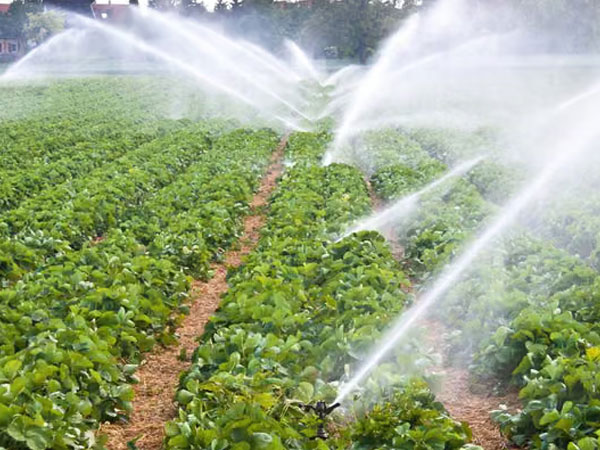
None of this means irrigation is emissions-free. Pumping water, whether for individual farms or larger interbasin transfers, takes energy, and that’s the single biggest source of irrigation’s direct emissions.
Smaller amounts come from nitrous oxide released through microbial activity in soil, and from dissolved carbon dioxide escaping when groundwater is sprayed across fields.
The pumping emissions, though, happen to be the easiest piece of the puzzle to fix.
Swapping fossil-fuel-powered pumps for electric ones could cut a meaningful chunk of irrigation’s direct footprint.
Moreover, the researchers suggest policymakers might consider incentives for that kind of electrification as part of broader climate-smart agriculture programs.
Looking at both sides of the ledger
Earlier research from this team had already catalogued irrigation’s direct emissions.
What makes this study different is that it’s the first to weigh those direct costs against the indirect benefits of avoided land-use change, putting both sides of the equation on the same scale for the first time.
“This comprehensive approach to accounting for direct emissions from the field and for the indirect land-use impacts lets us identify local opportunities to reduce emissions, through pump electrification and grid decarbonization, while also maximizing benefits associated with increasing productivity,” Driscoll said.
“Ideally, this is a win-win for addressing local emissions and also harnessing the global benefits of irrigation.”
Still, the study doesn’t account for emissions from other agricultural practices, like nitrogen fertilizer application or methane from livestock, which remain separate pieces of the food system’s overall climate footprint.
Water use is never a simple calculation
“We’re able to show this large benefit of U.S. irrigation to greenhouse gas emissions from the food system,” said co-author Nathan Mueller, a CSU associate professor.
“Yet, when we talk about water use, particularly in the western U.S., there are trade-offs with every use and trade-offs beyond food and beyond greenhouse gas emissions.”
“Our work provides one piece of the puzzle to help examine some of the very complicated societal cost-benefit questions surrounding water use.”
Why farmers depend on irrigation
For farmers in the arid West, the findings aren’t exactly a surprise.
CSU alumnus Alex Brown’s family has farmed and ranched the same land in Yuma County, Colorado, for 120 years, and irrigation isn’t optional there so much as foundational.
“We need irrigation to fulfill our needs and our duty to continue to feed the world,” Brown said.
Without it, farmers would have little choice but to plow up less productive, more ecologically sensitive pastureland to compensate, all while becoming dependent on rainfall that can’t be counted on.
“As the population increases, the demand for food increases and the demand for agriculture on less land increases.”
Brown said growers in Yuma County, one of Colorado’s top-producing counties for both crops and livestock, take conservation seriously, continually refining irrigation efficiency through better technology and modern equipment.
“I’m very passionate about it because I’d love to see our farm continue on for generations,” he said.
Weighing resilience against emissions
For Driscoll, the bigger takeaway is about how two seemingly separate priorities, feeding a growing population and cutting emissions, actually intersect.
“Irrigation is a powerful adaptation strategy,” she said.
“It increases productivity; it increases resilience to heat and drought stress, and of course, maintaining and increasing agricultural production is a critical priority.”
“At the same time, we need to reduce food system emissions, so understanding how those two challenges interact with one another is a priority. This work allows us to grasp some of those trade-offs and synergies a little better.”







© Copyright 2025 The SSResource Media.
All rights reserved.