

 Will the path to growing rice on the Moon soon open?
A Japanese research team has developed a technology to cultivate rice even in lunar soil. It is a method of growing rice by creating nitrogen fertilizer using only air and electricity. Experts predict it could become a core technology for long-term lunar base construction and the era of space habitation.
The joint research team from the Japan Aerospace Exploration Agency (JAXA) and Tohoku University announced they successfully produced nitrogen fertilizer from atmospheric nitrogen using plasma and cultivated rice seedlings in a lunar soil simulant. The research results were published in the international academic journal *Nature Partner Journal Microgravity (npj Microgravity)*.
For humanity to stay on the Moon long-term and build a lunar base, food self-sufficiency is essential. However, lunar soil contains no organic matter and lacks nitrogen sources like ammonia or nitrate, which are necessary for plant growth.
To address this, the team developed a small plasma device that creates nitrogen fertilizer using only air and electricity. The device synthesizes dinitrogen pentoxide (N₂O₅) by reacting atmospheric nitrogen and oxygen with electricity generated via solar power. Its power consumption is under 100W—equivalent to a single regular light bulb.
When the produced N₂O₅ gas is dissolved in water, nitrate (NO₃⁻) forms with nearly 100% efficiency. Nitrate is recognized as the most easily absorbed nitrogen nutrient source for plants.
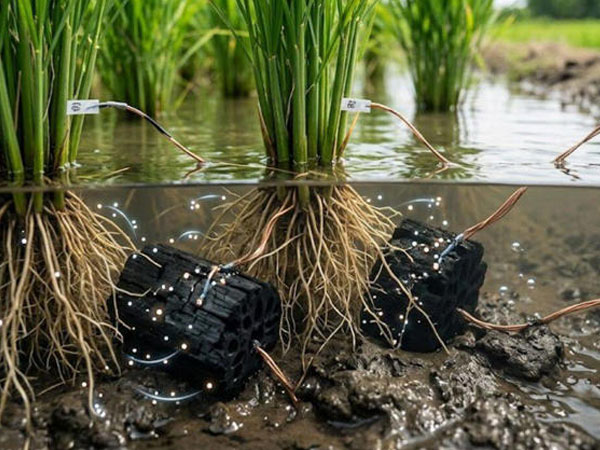
The researchers applied the nitrate solution to a lunar soil simulant and conducted rice seedling cultivation experiments. The simulant’s hydrogen ion index (pH), initially strongly alkaline at 9.09, dropped to 6.76—a level suitable for plant growth.
As soil acidity adjusted, trapped inorganic nutrients like calcium, magnesium, and potassium were released, making them easier for plants to absorb. Conversely, toxic aluminum ions (Al³⁺), which inhibit root development, decreased. Compared to using pure water alone, rice growth speed and condition improved significantly.
The team stated, “This technology proves nitrate fertilizer can be produced using only electricity,” adding, “It could contribute not only to sustainable lunar agriculture but also to reducing Earth agriculture’s environmental burden.”






© Copyright 2025 The SSResource Media.
All rights reserved.