

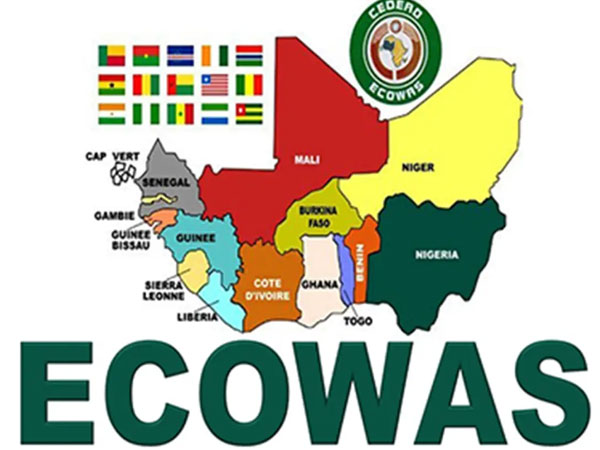
The Economic Community of West African States (ECOWAS) Commission has launched the Resilient Rice Value Chain Development Project (REWARD), a programme estimated at $650 million,
The West African region will need $25 billion to meet the 2035 target of 35 million tonnes of rice sufficiency.
The Commission also inaugurated a regional steering committee to oversee its implementation from 2025 to 2035.
REWARD is backed by the African Development Bank (AfDB) and supported technically by AfricaRice.
It aims to strengthen rice production, improve processing and marketing, and make locally produced rice more competitive.
Speaking at the launch, the ECOWAS Commission’s Vice President, Anthony Ogunjimi, said the project followed a directive from the region’s leaders.
“Our heads of state of ECOWAS gave the ECOWAS Commission a mandate to raise funding to ensure availability and food sufficiency for the subregion,”
Ogunjimi, who was represented by the Commission’s Commissioner for Economic Affairs and Agriculture, Mr Dephue Zuo Dephue, said the overall rice investment portfolio is about $25 billion.
“From the financing conference we had in Accra, we were able to raise 1.5 billion dollars, which is going to be used for the time being to ensure that we have access to financing for farmers, for business value chains, for production in the subregion,” he said.
“We want to encourage all West African citizens, business partners, and individuals with the resources to join this initiative,” he said.
Dephue said food sovereignty in West Africa depends on the region producing more of what it eats.
“West Africa’s food sovereignty depends on our ability to produce more of the food we consume and reduce our vulnerability to external shocks,” he said.
“Rice is central to this ambition. Yet, increased production alone will not deliver self-sufficiency,” he said, adding that fertiliser, irrigation, quality inputs, processing, financing, market access and the policy environment must also be addressed.
He said the Regional Rice Roadmap 2025-2035, which builds on the 2004 Yamoussoukro Declaration, puts investment needs at $25.6 billion.
He said the Accra investment roundtable generated about $1.5 billion in commitments, expressions of interest and ongoing discussions.
“Our responsibility now is to translate this interest into finance projects and tangible results for farmers, processors, and consumers,” he said.
ECOWAS’ contribution to REWARD, he said, covers regional policy and regulatory reform, coordination, better regulation of agricultural inputs and digital monitoring through the ECOWAS Rice Observatory.
The steering committee will provide strategic oversight and decision-making, and help identify bottlenecks early so that implementation stays accountable.
A representative of AfricaRice, Dr Sali Atanga, said poor access to quality seeds, low productivity, climate variability, inadequate mechanisation, post-harvest losses and fragmented markets are among the challenges facing rice production in West Africa.
“Addressing these challenges will require more than isolated national investments and interventions,” he said.
AfricaRice, he said, will concentrate on rice seed systems, climate-resilient varieties, sustainable production technologies, mechanisation and post-harvest management.
The Coordinator, ECOWAS RiceAgenda and REWARD Programme, Dr Boladale Adebowale, said five countries in the subregion have keyed into the programme in the first phase, adding that more will join in the second phase next year.



© Copyright 2025 The SSResource Media.
All rights reserved.