

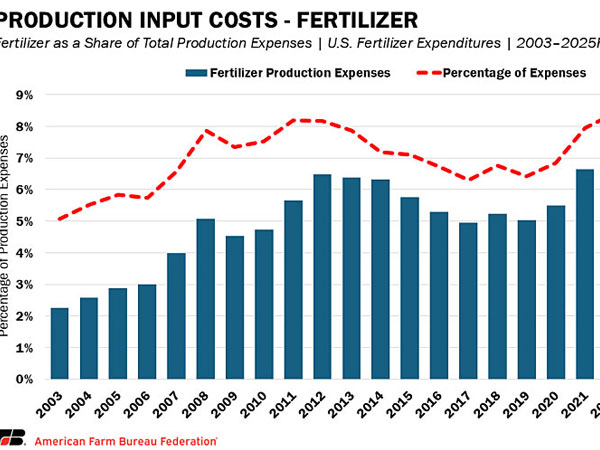
 Over the past five years, there has been considerable volatility in the fertilizer markets, from Russia’s invasion of Ukraine to the more recent military conflict in the Middle East that has disrupted maritime transit routes. These threats to the U.S. supply chain have redoubled efforts to safeguard fertilizer supply, reduce the risk of market disruption, and remove fertilizer duties that have impacted the phosphate fertilizer market.
Within the past week, several bills have been introduced, and others are under consideration to address the issue. On March 19, Senator John Thune (R-SD) introduced the bipartisan Fertilizer Transparency Act (S. 4152), which would require the U.S. Department of Agriculture (USDA) to collect and publish, on a weekly basis, data on fertilizer prices from manufacturers. Currently, USDA maintains an annual voluntary survey on the prices that producers pay for inputs. This legislation would provide better and more timely information to producers and is aimed at improving market signals to help ensure a more transparent and competitive marketplace. Senator Thune was joined by Senators Amy Klobuchar (D-MN), Chuck Grassley (R-IA), and Tammy Baldwin (D-WI).
On that same day, Senators Klobuchar and Roger Marshall (R-KS) introduced the Homegrown Fertilizer Act (S. 4148), which would establish a grant and loan program to boost domestic production and support small and mid-sized fertilizer producers.
In tandem with legislative efforts, national commodity groups sent a letter to the U.S. Department of Commerce on March 20, urging the Department to revoke the countervailing duty (CVD) orders on imports of phosphate fertilizer imposed in March 2021. The duties have had major effects on the phosphate fertilizer market—adding between 28-34 percent to the total price. At least one Moroccan company halted shipments of phosphate fertilizers to the U.S., leading to price hikes and shortages and saddling farmers with hardship that has only worsened in recent weeks amid the conflict in the Middle East.
This year, the duties will be examined under a sunset review process to determine whether they should be continued. The commodity group letter to Commerce Secretary Howard Lutnick follows a letter recently sent to Mosaic and Simplot urging them to support the sunset review and revocation of the duties.
“Like many crops, phosphate fertilizer is a key nutrient in the production of rice, and it is essential that Congress and the Administration continue to work creatively and collaboratively to strengthen the global supply chain and domestic production, as well as work to reduce the costs paid by farmers by allowing the CVDs to sunset,” said Jake Westlin, USA Rice vice president of government affairs. “Eliminating these duties would help restore balance to fertilizer markets by providing immediate relief to U.S. rice farmers facing elevated input costs and a lack of availability.”
In addition to these efforts, last fall the U.S. Department of Interior also published a “critical mineral” list, which included phosphate and potash. This designation, recognizing phosphate and potash as critical, will help guide a federal strategy and investment to bolster supply chains that are of importance to America’s national security (see USA Rice Daily, November 7, 2025).







© Copyright 2025 The SSResource Media.
All rights reserved.