

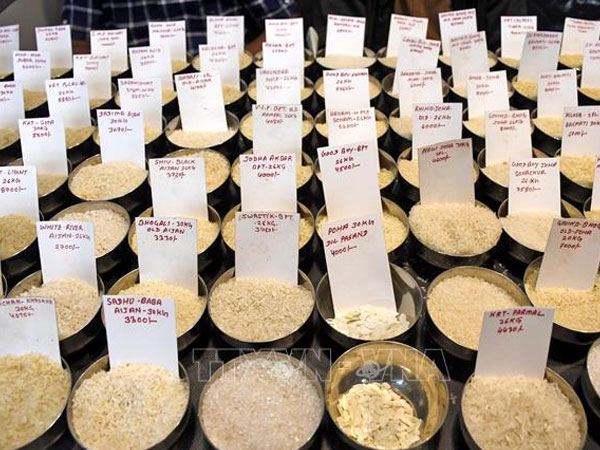
 Over the past week, Indian export rice prices have fallen due to oversupply and a record depreciation of the rupee.
Asian rice market:
Over the past week, Indian export rice prices have fallen due to oversupply and a record depreciation of the rupee. Conversely, the Vietnamese rice market has maintained stable prices, while Thai rice prices have tended to decline slightly amid geopolitical tensions in the Middle East impacting shipping activities.
According to export businesses, the price of Vietnamese 5% broken rice is currently being offered at 360-365 USD/ton, unchanged from last week. A trader in Ho Chi Minh City said that trading activity is slow because buyers are waiting for further price reductions, while domestic supply is increasing as the winter-spring harvest enters its peak period.
Preliminary data indicates that in February 2026, southern ports handled over 382,000 tons of rice, mostly exported to the Philippines and Africa. Although the conflict in Iran has not directly affected shipments from Vietnam to Africa, traders confirm that shipping costs have increased significantly due to rising insurance fees and fuel prices.
In India, the price of parboiled rice with 5% broken grains fell to $348-353 per ton from $350-356 per ton last week. White rice with 5% broken grains was listed at $346-351 per ton. The rupee's fall to a record low this week has helped exporters widen their profit margins and lower prices to attract international buyers.
However, Indian rice exports are facing significant logistical challenges. Approximately 400,000 tonnes of Basmati rice are currently stuck at ports or in transit. New export contracts have stalled due to freight costs doubling since the US-Israel-Iran conflict erupted.
In Thailand, the price of 5% broken rice also fell from $385 to $380 per ton. Traders in Bangkok believe that Thai rice is facing intense price competition from India, and are concerned that the El Niño phenomenon may reduce production in the near future.
The rice market is being directly impacted by the US-Israel and Iran conflict. The fighting has escalated after the US attacked an Iranian warship off the coast of Sri Lanka, paralyzing shipping through the Strait of Hormuz.
Global grain trading group Bunge said it is urgently seeking alternative transport routes to minimize disruption. Meanwhile, in Bangladesh, the government has instructed ministries to take urgent action to curb rising domestic rice prices, despite increased imports through both state and private channels.
The US agricultural market:
Agricultural commodities on the Chicago Board of Trade (CBOT) surged in price on March 6th following a warning from Qatar's Energy Minister about the risk of oil production disruptions in the Gulf due to the conflict, triggering a rise in oil and commodity prices in general.
Speaking to the Wall Street Journal, U.S. Treasury Secretary Scott Bessent expressed his expectation that China would continue to increase its purchases of U.S. soybeans. This information further bolstered investor optimism.
The market is currently focused on the U.S. Department of Agriculture's (USDA) monthly supply and demand report, scheduled for release on March 10th. Analysts forecast U.S. soybean inventories to range from 265 million to 384 million bushels, down from 350 million bushels in February 2026.
Regarding supply from South America, traders forecast Brazil's soybean production to average 179.20 million tons, lower than the USDA's 180 million tons forecast last month. Conversely, AgroConsult raised its forecast for Brazil's harvest by 850,000 tons to 183.10 million tons.
Soybean production from Argentina is expected to decline slightly to 48.10 million tonnes from the previous 48.50 million tonnes. The Buenos Aires Grain Exchange rated the quality of the soybean crop at good/excellent 30%, up 1 percentage point from the previous week.
Actual figures show that Brazil's soybean exports in February 2026 reached 7.11 million tons, a 10.7% increase compared to the same period last year. However, Brazil's National Food Supply Agency (Conab) reported that the harvest progress was only about 42%, 6 percentage points slower than the previous crop year.
Corn futures prices also rose in line with crude oil's upward trend. Analysts predict the USDA will revise Brazil's corn production forecast upwards to 132.90 million tons, up from 131 million tons in February 2026. Conversely, Argentina's corn harvest forecast has been lowered by 100,000 tons to 52.90 million tons.
Brazil has completed harvesting 25% of its first corn crop, level with 2025 production, and has planted 65% of its second corn crop. In Argentina, the Buenos Aires exchange maintained its production forecast at 57 million tons, with 7% of the crop harvested and the percentage of good/excellent quality crops surging 11 points to 55%.
Forecasts indicate that U.S. corn inventories at the end of March 2026 will be between 2.03 billion and 2.43 billion bushels, compared to 2.13 billion bushels the previous month.
Wheat futures prices rose due to the overall impact from the energy market and weather concerns. The U.S. Drought Monitor reported that the area of winter wheat affected by drought increased by 6 percentage points to 56%, and the area of spring wheat affected by drought also increased by 3 percentage points to 19%.
U.S. wheat reserves, currently at 931 million bushels, are expected to fluctuate between 856 million and 956 million bushels.
The global coffee market:
Coffee prices continued to rise on both international exchanges. At the close of the most recent trading session, robusta coffee prices on the London exchange rose across all delivery periods. Specifically, the January 2026 contract increased by $21/ton to $3,827/ton. Similarly, the November 2026 contract also increased by $2/ton, reaching $3,511/ton.
Meanwhile, Arabica coffee prices on the New York exchange also recorded gains across all contract periods. Specifically, the March 2026 contract increased by 4.6 cents/lb to 297.6 cents/lb. The December 2026 contract increased by 3.8 cents/lb to 277.65 cents/lb (1 lb = 0.45 kg).
On the Brazilian exchange, arabica coffee prices showed mixed movements across different delivery periods. The March 2026 contract rose 2.75 cents/lb to 380 cents/lb, while the May 2026 contract fell 0.9 cents/lb to 349.5 cents/lb.
Coffee prices in the Central Highlands region on March 7th remained unchanged compared to yesterday, fluctuating between 95,500 and 96,600 VND/kg.
Traders said the market continues to be impacted by concerns about logistical disruptions related to armed conflict in the Middle East, while selling activity from farmers in some major producing countries is also trending slower.
Although sea freight routes from Vietnam to Europe have not been completely disrupted, shipping costs have increased significantly compared to before. These rising logistics costs are putting pressure on coffee roasters and importers, and making the market more sensitive to fluctuations in the supply chain.
In the short term, the coffee market forecast continues to be concerned about logistical disruptions related to armed conflicts in the Middle East. It is strongly impacted by both supply and demand factors and global geopolitical fluctuations, particularly the tensions in the Middle East. At the same time, sales from farmers in some major producing countries tend to slow down.











© Copyright 2025 The SSResource Media.
All rights reserved.