

 Kunal Sharma outlines how India Gate blends culture, content, and quick commerce to stay relevant during Ramadan, focusing on authenticity, younger consumers, and evolving festive consumption habits.
Every year, when Ramadan begins, there is a familiar rhythm inside Indian homes that observe the fast. Sehri is quiet, usually rushed. But iftar is an event. The dastarkhwan gets laid carefully. Family trickles in. And at some point, biryani appears, because it almost always does. Not as a showpiece, but as the meal that signals the end of the day's fast, the one that says: everyone is here, sit down.
For food brands, this is a window that is easy to notice but harder to actually earn. The instinct is to show up with imagery of lanterns, crescent moons, and a family shot around a table. The harder thing is to understand what the month is actually about and let the product find its place inside that, quietly.
India Gate, KRBL's flagship basmati rice brand, has been working on the latter for several years now. This Ramadan, with Eid falling on March 21, the brand has also stepped into a new category: biryani masalas. Alongside its rice, it has launched a campaign for its Classic Biryani Masala range, bringing together quick commerce partnerships, digital films, creator content, and an OTT integration. The ambition is not just to be visible during the festival but to be useful in the act of cooking it.
KRBL holds roughly 42% of the domestic branded basmati rice market, according to industry reports. That kind of category dominance gives the brand some room to experiment. But the Ramadan push is less about dominance and more about what Kunal Sharma, Vice President of Marketing and Organized Trade at KRBL, describes as the brand's relationship with culture at large.
"India is a unification, a potpourri of cultures," Sharma said. "Food is at the centre of all of this. It holds people together at all our celebration occasions."
That is also, practically speaking, why Ramadan makes commercial sense for a premium rice brand. The month drives real consumption.
Ramadan media mix: 50% budget towards video
"We see a significant 20 to 30% uplift during this period of time in our premium portfolio sales," Sharma said, on the back of quick commerce and modern trade.
Some of this comes down to the calendar. February is short, following January, which is already a peak month. By March, when Ramadan typically falls, households are in a cooking-and-gathering mindset. Meals get bigger. Guest lists get longer. The kind of rice or masala someone buys starts to matter more.
But beyond calendar timing, quick commerce platforms have changed what festive consumption looks like. Platforms like Blinkit, Zepto, Swiggy Instamart are not simply delivery channels.
WPP Media’s report highlights that 45% of festive shopping now occurs on quick-commerce platforms, which are set to capture 16% of India’s e-commerce market by 2027.
During Ramadan, these platforms build dedicated storefronts, curate ingredient bundles, and create editorial moments around the festival. A consumer who might have planned their biryani shopping three days in advance can now decide at 5 pm and have everything at the door before iftar. The platforms have, in Sharma's words, "created these consumption occasions for consumers."
India Gate leans into that. The brand avoids mainline television during this period almost entirely, because the audience it wants to reach during Ramadan is findable online in ways that a TV spot cannot match. "It is possible for us to target them in an ecosystem," Sharma said, "and hence our media choices during this period gravitate towards digital more and digital-forward kind of initiatives."
The budget split reflects this.
“50% goes into video promotions, largely in collaboration with our partners on digital, be it OTT or YouTube and Meta and Facebook. Typically, 30% goes towards influencers and content creators. The remaining 20% is invested in on-app investments, taking up visibility on the platforms or in the stores.”
The brand has an integration with Laughter Chefs Unlimited Entertainment, placing it within a cooking-entertainment format rather than interrupting a show with an ad.
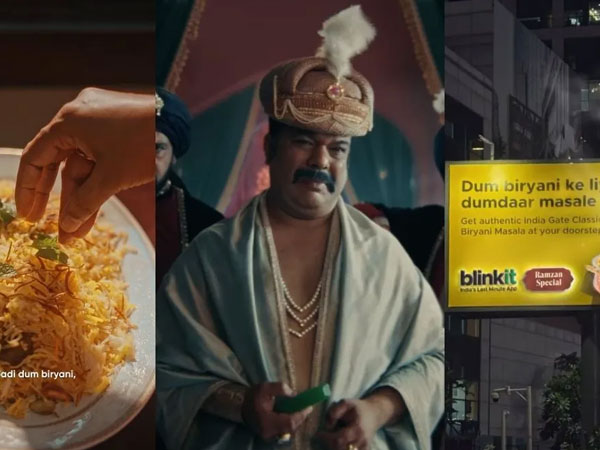
The brand has also run an OOH campaign with Blinkit that reads: "Dum Biryani ke liye dumdaar masale liye? Get authentic India Gate Classic Biryani Masala at your doorstep."
Capturing the emotions associated with the festival
What’s important during festivals is to get the emotions right. Ask anyone from Lucknow or Hyderabad which biryani is better, and prepare for a very long conversation. The two styles are genuinely different: Lucknowi dum biryani is delicate, the meat and rice cooked together slowly, the spicing subtle. Hyderabadi biryani is bolder and layered, with the masala doing most of the talking. People have strong opinions. Cities have an identity tied up in it.
India Gate's digital film for this Ramadan uses that tension as its starting point. A consumer climbs into a time machine and lands in the Mughal era, where a royal cook keeps being pardoned by the king for his impertinence, because his biryani is too good to hold against him. The joke lands when the king's guards tell the cook that anyone can now recreate that authenticity at home. Cue the masala range.
It is a comic device, but it is doing something specific. The consumer the brand is targeting is not the one who has their grandmother's masala recipe memorised.
Sharma describes, "We are talking to a slightly younger audience who are staying maybe as nuclear families away from their families or their original places, moved to a metro for their professional pursuits, and are slightly short on time and more on expertise." They know what authentic biryani should taste like. They grew up eating it. But they do not know how to make it that way.
The brand could have positioned the masala range purely on convenience. Ready-to-cook products always do that. Sharma was deliberate about going elsewhere. The promise the brand is making is authenticity, not speed.
The influencer campaign carries the same idea without restating it. Creator Maroof Umar made a video that begins with the texture of Ramadan itself: the patience of the fast, the preparation as sunset approaches, the laying out of the dastarkhwan. Biryani comes in not as a product moment but as the natural end of the day. His caption to the video asked his audience a simple question: Lucknowi or Hyderabadi? Or maybe, this Ramadan, both. The brand appears, but it is not the point of the conversation.
This is more or less the philosophy India Gate has applied across its Ramadan campaigns over the years. In 2022, the #EmotionCalledBiryani campaign sent over 150 influencers to document biryani culture in cities like Lucknow, letting the dish carry the emotion rather than the product. In 2019, a film followed a man who revisited his childhood neighbourhood during Ramadan and brought children with him to share a plate of biryani. That campaign ran alongside World Hunger Day, and it worked because sharing food is what Ramadan is actually about, not just visually but in practice.
The common thread is that the brand has not tried to own the festival. It has tried to be present inside it without requiring the festival to be about the brand.
Sharma put it through a food analogy. "If you ever had rice with a curry, and you pour the curry into the rice, the rice absorbs it. It should be so seamless that it should flow around the consumer's life. It should not be something that is pushed on to them, something that is pedantic, something that is preachy, but something that the consumer sees as value."
That is a harder bar than most brands set for themselves, especially during moments like Ramadan, where the temptation to signal cultural awareness can override the instinct to actually demonstrate it.
Looking ahead, Sharma thinks the festival marketing landscape is going to expand rather than consolidate. More people in urban centres are celebrating more festivals, partly because city life fragments people from their original communities, and festivals become a rare occasion to gather.
Platforms are helping create these moments even around smaller occasions that would not have registered on a brand's calendar a decade ago. His read on how brands should navigate the crowded calendar: follow consumption if the goal is revenue, follow brand fit if the goal is relevance, and watch for the smaller moments where there is less noise and more room to actually land.
For a brand built around a staple that sits at the centre of nearly every major Indian meal, that is not a difficult brief to work with. Ramadan just happens to be where the stakes feel highest.






© Copyright 2025 The SSResource Media.
All rights reserved.