

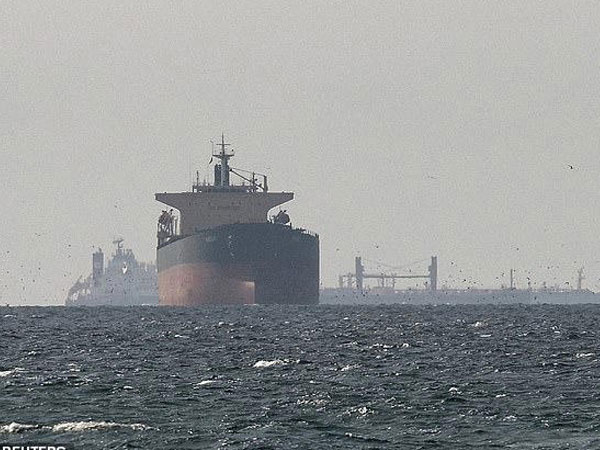
 Iran has warned that oil tankers will be destroyed if they try to travel along the Strait of Hormuz without permission, as it seeks to retain control over the passage during the two-week ceasefire.
A radio message was today broadcast by the regime to all oil ships in the vital waterway, saying: 'If any vessels try to transit without permission, [they] will be destroyed.'
The Islamic Republic is demanding that shipping companies pay enormous tolls in cryptocurrency to access the passage, which usually handles around 20 per cent of the world's oil and gas.
The future of the strait is a major sticking point between Washington and Tehran, with US President Donald Trump calling for the free flow of maritime traffic to be restored.
'Iran needs to monitor what goes in and out of the strait to ensure these two weeks aren’t used for transferring weapons,' Hamid Hosseini, a spokesperson for Iran’s Oil, Gas and Petrochemical Products Exporters’ Union, told the Financial Times.
'Everything can pass through, but the procedure will take time for each vessel, and Iran is not in a rush,' he added.
Each vessel will have to first email the authorities about its cargo, after which Iran's Supreme National Security Council will alert them about the toll to be paid in digital currencies.
Hosseini said the toll would be $1 per barrel of oil, adding that empty tankers can pass freely.
His statements imply that Tehran will demand that vessels use the northerly route close to its coastline, raising concerns over whether western or Gulf state-linked tankers will be willing to risk transit.
'Once the email arrives and Iran completes its assessment, vessels are given a few seconds to pay in bitcoin, ensuring they can’t be traced or confiscated due to sanctions,' Hosseini told the newspaper.
Such comments outlining Iranian control of the strait contradict statements coming out of the White House - heightening fears about the potential for a lasting peace between the warring sides.
In a post on Truth Social on Tuesday night, the US President made it abundantly clear that the two-week ceasefire was dependent on 'the Islamic republic of Iran agreeing to the COMPLETE, IMMEDIATE, and SAFE OPENING of the Strait of Hormuz'.
In contrast, Iran's foreign minister Abbas Araghchi has said traffic will flow 'via coordination with Iran’s Armed Forces and with due considerations to technical limitations', raising concerns about the future of not just for oil and gas - but also jet fuel, sulphur, urea, and diesel.
Western ship owners announced today they were adopting a cautious approach, while waiting for updates on how and whether the waterway might reopen.
So far, no tankers are currently braving the transit apart from two linked to Tehran.
Maersk, the globe's second biggest shipping line, said it is 'working with urgency' to clarify the regime's terms.
'The ceasefire may create transit opportunities, but it does not yet provide full maritime certainty,' the company added, making clear it would continue to take a 'cautious approach' with cargoes and was not yet making changes to specific services.
Gulf states including Saudi Arabia, Qatar and the UAE will likely find it highly unpalatable if Tehran continues to control traffic through the vital oil passage.
The situation also raises questions for Opec+, the oil producers’ group, with experts warning that handing the Islamic Republic control of Hormuz could fundamentally shift the balance of power within the organisation by giving Tehran a potential veto over rival members’ exports.
'Allowing Iran any form of control over the strait would be a red line,' said Ali Shihabi, a commentator close to the Saudi royal courts.
'The priority has to be unimpeded access through the strait,' he added, saying the kingdom demands 'unimpeded' access to global markets.
The closure of the waterway since the start of the war has led to a spiralling energy crisis around the world, with surging crude prices triggering higher pump prices for motorists.
Despite the fact that the US and Iran have struck a deal to reopen the strait, experts have warned that oil tankers are expected to continue avoiding it, meaning there is no end in sight for high fuel prices.
While oil prices plunged below $100 per barrel after Trump announced a last-minute ceasefire on Tuesday night, the lack of ships traversing the strait means that vital crude and gas supplies from the Middle East will continue to be disrupted.
Lars Jensen, a shipping analyst with Vespucci Maritime, told the Telegraph: 'Technically speaking they could pull anchor and start moving now, but that is not what is likely to happen.
'I expect that what we will see in the next few days, if the ceasefire holds, is a lot of vessels exit the Persian Gulf but not very many vessels enter into the Persian Gulf.
'Shipping lines would be hesitant in trusting the longevity of the ceasefire at this point and therefore [would] try to get vessels out, so they can use them, but not risk putting new vessels into the Gulf that might then be trapped if the ceasefire breaks down.'
The RAC motoring group already warned that despite the sharp drop in crude oil prices today, the outlook for drivers in the UK remains 'highly uncertain' without an uptick in oil shipments.
'The conditional ceasefire announcement may have taken some heat out of global oil prices, but the outlook for drivers in the UK remains highly uncertain,' RAC head of policy Simon Williams said.
'The best hope in the short term is that pump prices stop rising at the rate they have been and hopefully top out in the coming days.
'Much will depend on the stability of the ceasefire, whether oil shipments can move freely through the strait of Hormuz, and the longer‑term impact on oil production across the Gulf. As it is a sustained lower oil price – over several weeks, not just a few days – that is required to bring wholesale fuel costs down meaningfully.'
Saudi Arabia’s key East-West pipeline, which the kingdom has been using to reroute oil exports to the Red Sea, was attacked by a drone today, despite the announcement of a ceasefire.
Roughly 175mn barrels of crude and refined products are currently loaded on to 187 vessels in the Gulf, according to Kpler data - which could now start to shift, depending on the future of the Hormuz Strait.
According to industry executives, between 300 to 400 vessels are waiting to exit the Gulf as soon as it is possible to pass without danger, with one describing it as a 'car park'.
Martin Kelly, head of advisory at maritime intelligence group EOS Risk, told the FT that there was 'no way' that the backlog of tankers waiting to get out could be cleared in two weeks.
In recent weeks, a handful of ships approved by the regime have been allowed to pass through the strait via a specific route, largely limited to vessels not connected to the US, Israel or Gulf states that had provided staging for attacks.
If such a mechanism was adopted now, only around 10 to 15 ships might be able to traverse the strait per day as the process was 'quite time-consuming', he said, down from 135 ships before the conflict.
Despite the ceasefire, strikes appear to be continuing, with Kuwait this morning reporting Iranian attacks which damaged power and desalination plants as well as oil facilities.
And there is fundamental disagreement about what the ceasefire even entails, with Israeli Prime Minister Benjamin Netanyahu insisting it doesn't include Lebanon, where Israel has been fighting the Iranian-backed armed group Hezbollah.
According to Pakistan's prime minister Shehbaz Sharif, Lebanon is included, but the IDF nevertheless carried out a large wave of air strikes across the country this morning.
Across Lebanon, more than 1,500 people have been killed, including 130 children, while than 1.2 million people have been displaced - one in five of the population.












© Copyright 2025 The SSResource Media.
All rights reserved.