

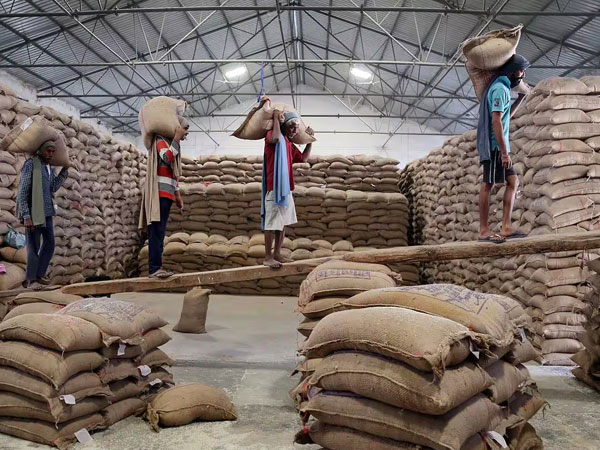
 Minister Amir Khosru Mahmud Chowdhury has defended Bangladesh’s latest inflation figures, saying lower rice and meat prices helped bring July’s rate down.
On Wednesday, Khosru said the Bangladesh Bureau of Statistics (BBS) had reported the figures “accurately” after he personally checked rice and meat prices.
A journalist had questioned the credibility of the figures, saying prices of everyday essentials had risen in July despite the reported fall in inflation.
Khosru said the government would not allow misleading information in official data and had asked the BBS to provide accurate figures so policies could be based on reliable information.
The briefing followed the closing session of a national conference on implementing a five-year strategic framework for the Sustainable Development Goals (SDGs), held at the Bangladesh-China Friendship Conference Center.
State Minister for Planning Zonayed Saki, who attended the event, said the government would hold discussions with journalists on how inflation is measured and explain the process in detail.
The BBS usually publishes monthly inflation data between the second and third day of each month.
It, however, released the July figures on Tuesday, Aug 11.
The latest data put point-to-point headline inflation at 8.32 percent in the first month of the 2026-27 fiscal year, the lowest in eight months.
The figures have drawn questions as Dhaka’s kitchen markets remained volatile towards the end of July amid prolonged monsoon rain and waterlogging in several districts.
Vegetable prices rose by Tk 20 to Tk 40 a kg amid supply shortages, with most varieties selling for more than Tk 100 a kg.
Green chillies were among the costliest, reaching Tk 340 to Tk 400 a kg depending on quality and market.
Egg prices also remained high.
Trading Corporation of Bangladesh data put broiler chicken prices up by as much as 11 percent.
According to Saki, Bangladesh faces a $4.02 trillion financing gap in achieving the Sustainable Development Goals (SDGs), equivalent to more than Tk 50 trillion.
He called the gap a major challenge as the government prepares its action plan.
Asked about the financing gap, Khosru said: “We want to move beyond traditional public financing because there are limitations. We are now looking at alternative financing as the global public finance architecture has changed.”
The government was looking to bridge the gap through the stock market, capital market, bonds and sovereign funds, while also working to raise the tax-to-GDP ratio, he added.





© Copyright 2025 The SSResource Media.
All rights reserved.